Reliable electricity is an important part of keeping a construction project running. From power tools and lighting to pumps, compressors and temporary site facilities, many jobs depend on having a dependable source of power available where and when it is needed.
For projects without a permanent mains connection, a generator can provide the independent power required to keep work moving. The challenge is choosing a model that has enough capacity for your equipment without paying for unnecessary output or dealing with a generator that is impractical to transport around the site.
There are several factors to consider when selecting a generator for construction work. Power requirements, starting loads, fuel type, electrical phase, runtime, portability and operating conditions all have a bearing on which generator will be suitable.
This guide looks at the key considerations when choosing a construction site generator in the UK, helping you understand what to look for before making a purchase.
Why Do Construction Sites Need Generators?
Not every building project has access to a convenient mains electricity supply. New developments, extensions, remote jobs and temporary works can all require electrical power before a permanent connection is available.
Even on sites where mains electricity is accessible, a generator can provide an additional source of power for equipment operating away from the main connection.
Depending on its output and configuration, a construction generator can be used to supply:
- Electric power tools
- Temporary site lighting
- Concrete mixers
- Water pumps
- Air compressors
- Battery chargers
- Site offices and welfare facilities
- Other temporary electrical equipment
The amount of power required will vary considerably between projects. A tradesperson carrying out a small renovation will have very different requirements from a contractor working on a large commercial development.
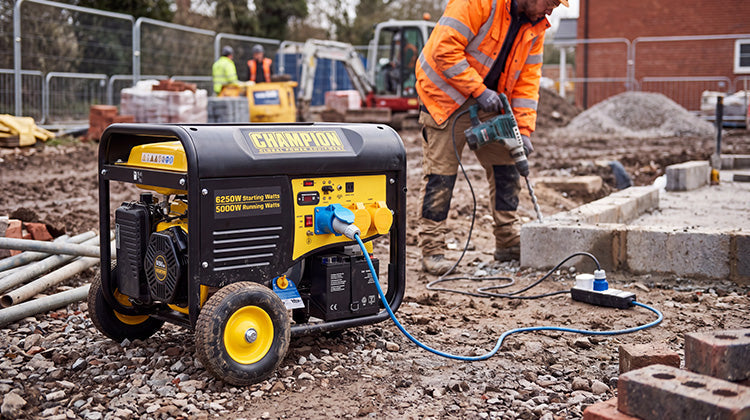
Champion's construction generator range includes models across a range of power outputs, allowing you to select equipment according to the demands of your particular application.
How Much Generator Power Do You Need?
Getting the generator capacity right is one of the most important parts of the selection process.
An undersized generator may overload when several tools are being used, while choosing a substantially larger machine than necessary can mean carrying additional weight and using more fuel than required.
Start by making a list of everything that could need power from the generator. Once you know which equipment will be connected, you can work out the approximate electrical load.
Start With Running Watts
The running wattage tells you how much electricity an appliance or tool normally consumes while it is operating.
If, for example, your site requires a 1,200W tool and 600W of lighting at the same time, the running load would be approximately 1,800W.
However, simply adding the running wattages does not give you the complete picture. Equipment with electric motors can require a much larger burst of power when it starts.
For this reason, you should always consider both the normal running load and the starting demand before selecting a generator.
Don't Forget Starting Watts
Some electrical equipment draws considerably more power for a short period when its motor starts. Pumps, compressors, mixers and certain power tools can all have a higher starting requirement than their normal running wattage.
This temporary increase is sometimes referred to as starting watts or surge watts.
A generator therefore needs enough available capacity to cope with the highest likely demand, not simply the combined running wattage of the equipment.
It is also worth considering how your equipment will be used. Starting several motor-driven machines simultaneously can create a much larger initial load than starting them individually.
For larger or more complicated installations, a qualified electrician or electrical professional should assess the expected load before the generator is selected.
Typical Generator Sizes for Building Work
There is no single generator size that suits every construction project. As a broad guide, different output ranges can be suitable for different levels of demand:
| Generator Output | Example Applications |
|---|---|
| Up to 3,500W | Portable tools, lighting and smaller temporary electrical loads |
| 3,500W–7,500W | Several tools, pumps, mixers and higher-demand site equipment |
| Above 7,500W | Larger sites, heavier equipment and substantial electrical loads |
These figures should only be used as a starting point. The actual generator requirement will depend on the equipment being powered, its starting characteristics and which items need to operate at the same time.
Champion currently offers construction generators from around 3,000W through to 8,000W petrol models, with additional higher-output diesel options available within the wider generator range.
Which Fuel Type Is Best for Construction?
Once you've established how much power you need, the next consideration is how the generator will be fuelled.
Petrol, LPG dual fuel and diesel generators can all have a place on a construction site. The most appropriate option depends on the size of the generator, how frequently it will be operated and the conditions in which it will be used.
Petrol Generators for Construction
Petrol generators can be particularly useful where portability and flexibility are important.
Smaller petrol models can provide a convenient power source for tradespeople and contractors who need to move a generator between different areas or transport it from one job to another.
Depending on the model, a petrol generator can be suitable for powering:
- Handheld power tools
- Lighting
- Small pumps
- Battery chargers
- Temporary site equipment
Champion's portable petrol range includes models such as the 3,200W and 3,500W generators, as well as larger 5,500W and 8,000W options for applications requiring additional output.
Dual Fuel Generators
A dual fuel generator provides the option of running on either petrol or LPG, which can be useful when flexibility over your fuel supply is important.
Having two fuel options can make it easier to adapt to different working conditions or fuel availability. LPG can also be useful where propane is already being used elsewhere on the site.
Champion's dual fuel range includes the SitePro 3000W generator, as well as larger models for applications requiring greater output.
Always check the specifications of the individual generator before choosing a fuel. The available power can vary depending on whether the machine is operating on petrol or LPG.
Diesel Generators
Diesel generators are commonly considered for applications where higher output or extended operation is required.
They can be appropriate for larger construction projects and applications where the generator is expected to supply substantial electrical loads for longer periods.
When considering a diesel generator, look beyond the headline power rating. Fuel tank capacity, fuel consumption, expected runtime and ease of refuelling can all affect how practical the generator will be for your project.
A diesel generator isn't automatically the best choice simply because it offers a higher output. For a small renovation requiring a handful of portable tools, a compact petrol or dual fuel generator may be more practical.
Single-Phase or Three-Phase: Which Do You Need?
The electrical requirements of your equipment will determine whether you need a single-phase or three-phase generator.
This is something that should be established before purchasing the generator, particularly if you intend to operate commercial or industrial machinery.
Single-Phase Generators
Single-phase generators are suitable for many of the tools and electrical devices found on smaller construction projects.
Typical applications can include:
- Power tools
- Portable lighting
- Battery chargers
- Small pumps
- Site office equipment
If all of the equipment you intend to connect uses a single-phase supply, a suitable single-phase generator may provide everything you need.
Three-Phase Generators
Some larger machinery and industrial equipment requires a three-phase electrical supply. In these situations, a three-phase generator may be necessary.
Before selecting a three-phase model, check the electrical specifications of the machinery you intend to operate.
It's also important to understand how the generator's output is distributed. The total rated output of a three-phase generator isn't necessarily available through one socket or one phase, so the way the electrical load is balanced across the phases can be important.
Where a site involves a complicated three-phase electrical installation, the generator should be selected and connected with the advice of a suitably qualified professional.
Does the Generator Need to Be Portable?
The physical layout of a construction site can have a major influence on the type of generator that makes sense.
If power is required at different points around the site, portability becomes an important consideration.
Portable Generators
A portable generator can be moved to wherever temporary power is required. This can be particularly useful for tradespeople and contractors working across different parts of a project or travelling between jobs.
Don't judge portability by weight alone. The overall dimensions, wheel kit, handles and lifting points can all affect how easily a generator can be positioned.
Champion's portable construction models are available with features such as wheel kits and heavy-duty frames to help make transportation and positioning more practical. For example, the 5,500W Champion petrol generator has a tubular steel frame and included wheel kit.
Generators That Stay in One Location
If the generator will remain in one area for most or all of the project, portability may be less important than output, fuel capacity and long-term operating characteristics.
Larger construction sites may use a generator to supply power to several areas or pieces of equipment. In these circumstances, careful consideration should be given to positioning, ventilation, cable routing, fuel access and electrical distribution.
How Long Should a Construction Generator Run?
Runtime becomes increasingly important when a generator is expected to operate throughout the working day.
When comparing generators, remember that advertised runtime is normally based on a particular load. A machine quoted as running for a certain number of hours at 50% load may use considerably more fuel when operated close to its maximum rated output.
Consider the following when assessing runtime:
- How many hours the generator will operate each day
- The average load during normal use
- The fuel tank capacity
- Fuel consumption at different loads
- How frequently refuelling will be required
- Whether the generator can be safely stopped when refuelling is necessary
For example, the Champion 8,000W petrol generator has a 25-litre fuel tank and is rated for up to 10 hours of operation at 50% load. Its actual runtime will vary according to the load placed on the generator.
Looking at fuel consumption alongside tank capacity will give you a better understanding of how a generator is likely to perform during a typical working day.
Should You Consider Generator Noise?
Construction sites are rarely quiet, but generator noise can still be an important consideration depending on where the machine is positioned.
This is particularly relevant when working:
- Close to houses or residential properties
- Near neighbouring businesses
- Beside offices or welfare facilities
- In areas where workers spend extended periods
- On sites where noise restrictions apply
When comparing noise figures, make sure you are comparing measurements taken under similar conditions. The distance from the generator and the load at which the measurement was taken can affect the reported noise level.
For example, Champion's 5,500W and 8,000W petrol generators are both listed at 74 dBA at 7 metres, while the Champion 3,600W dual fuel inverter is listed at 61 dBA at 7 metres.
This demonstrates why the generator's design and intended application should be considered rather than assuming that all generators of a similar output will produce the same noise level.
Generator Safety on a Building Site
A generator should always be installed, positioned and operated according to the manufacturer's instructions.
Construction environments can introduce additional hazards, so think carefully about where the generator is placed and how its cables and electrical connections are routed.
Important precautions include:
- Operate the generator in a properly ventilated outdoor location
- Keep the generator away from combustible materials
- Protect electrical cables from vehicles, machinery and other sources of damage
- Keep leads and cables away from walkways where possible
- Use suitable electrical distribution equipment
- Inspect plugs, leads and connections before operation
- Follow the generator manufacturer's operating instructions
- Carry out the required servicing and inspections
Never operate a petrol, diesel or LPG generator inside an enclosed or poorly ventilated space.
Generator exhaust contains carbon monoxide, an odourless and potentially fatal gas. A garage, shed, container, basement or other enclosed area is not a suitable location for a portable generator.
Some Champion generators are equipped with safety features such as low-oil shutdown and, on applicable models, CO Shield technology. These features provide additional protection but do not replace the need for correct generator placement and safe operating practices.
Where a generator forms part of a more complex site electrical installation, connection and installation should be undertaken by an appropriately qualified professional.
Maintaining a Generator on a Construction Site
A construction environment can be hard on equipment. Dust, dirt, vibration, transportation and frequent handling can all take their toll on a generator over time.
Following the manufacturer's maintenance schedule can help identify problems before they affect the generator's operation.
Depending on the generator model, routine checks may include:
- Engine oil level and condition
- Air filter
- Fuel filter and fuel system
- Battery and starting system
- Spark plug on petrol engines
- Coolant on applicable engines
- Electrical cables and connections
- Fuel lines and signs of leakage
- General condition of the frame, wheels and controls
Keep a record of operating hours where required and follow the servicing intervals specified for your particular model.
If the generator is regularly transported between construction sites, give it a visual inspection before use. Check for damage caused during transportation and make sure wheels, handles, cables and connections remain secure.
What Should You Check Before Buying a Construction Generator?
Once you've established that a generator is suitable for your project, run through the following questions before choosing a model.
What are you going to power?
Make a list of the tools, machinery, lighting and other equipment that will need electricity.
What is the total running load?
Add together the running wattages of the equipment that may be operating simultaneously.
What are the starting requirements?
Check whether motors, pumps, compressors or other equipment require additional power when starting.
What type of electrical supply is required?
Establish whether your equipment requires single-phase or three-phase power before selecting the generator.
Will the generator need to move?
If you're taking the generator between different areas or sites, look at its weight, dimensions, wheels, handles and lifting arrangements.
How many hours will it operate?
Compare fuel capacity and consumption with the number of hours you expect the generator to run each day.
Where will the generator be positioned?
Make sure there is adequate ventilation and sufficient space around the machine for safe operation, access and maintenance.
What conditions will it encounter?
Construction sites can be dusty, dirty and demanding environments. Consider whether the generator's design is appropriate for the conditions in which it will be used.
Choosing a Generator for Your Construction Project
The right construction generator isn't necessarily the largest or most powerful model available. The best choice is one that matches the electrical demands of your equipment, the way you work and the conditions in which the generator will operate.
For smaller jobs, a portable petrol generator can provide a practical source of temporary electricity. Where flexibility over fuel is useful, a dual fuel model provides the option of petrol or LPG. Larger projects with greater electrical demands may call for a higher-output generator, including diesel models and three-phase configurations where required.
Champion's construction generator range is designed around the demands of the worksite, with models covering different power outputs, fuel types and applications. Champion's UK range currently includes portable generators from around 2,200W through to 8,000W, as well as larger diesel options within the wider range.
Before making your choice, calculate the equipment load, allow for starting power, establish the required phase and consider how often and where the generator will be used.
If you're unsure which generator capacity is suitable for your application, use the Champion Generator Wattage Calculator to help determine your power requirements, or explore the Champion construction generator range.